Blog
How AI Scribing Is Quietly Transforming Clinical Efficiency and What the Data Actually Shows
AI scribing is already in use across thousands of clinical settings, and the outcomes are being measured. Here is what the data shows about documentation time, physician satisfaction, and patient experience.
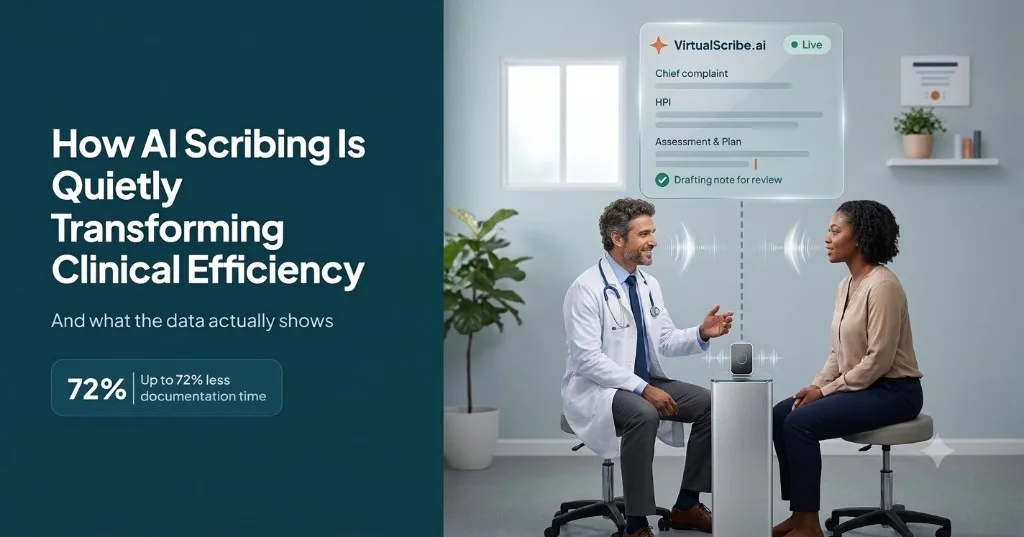
There's a version of the AI in healthcare conversation that lives entirely in the future tense. Predictions, projections, and promises about what artificial intelligence will eventually do for medicine.
This blog isn't that.
AI scribing is already in use across thousands of clinical settings. The outcomes are being measured. The data is coming in, and what it shows is less about futuristic transformation and more about a straightforward, immediate problem being solved in real time: physicians are drowning in documentation, and AI is pulling them out.
The Documentation Problem Is Bigger Than It Looks
Before getting to what AI scribing does, it's worth being precise about what it's solving.
Physicians in the United States spend an average of 1.8 hours on administrative tasks, primarily documentation, for every hour of direct patient care, according to research published in the Annals of Internal Medicine. That ratio has worsened steadily as EHR requirements have grown more demanding, quality reporting has expanded, and patient panels have increased in complexity.
The American Medical Association has consistently identified EHR burden and documentation time as among the top drivers of physician burnout, a problem that costs the U.S. healthcare system an estimated $4.6 billion annually in turnover, reduced productivity, and early retirement, according to research published in Mayo Clinic Proceedings.
The math is straightforward: when a physician spends two to three hours per day on documentation, that's time not spent on patients, not spent on clinical thinking, and not spent on the kind of work that drew most physicians to medicine in the first place.
What AI Scribing Actually Does
AI scribing uses ambient voice recognition and natural language processing to listen to a physician-patient encounter in real time and generate a structured clinical note automatically, without the physician needing to type, dictate, or manually enter data after the visit.
The physician reviews the note, makes any necessary edits, and signs off. What previously took 10 to 15 minutes of post-visit documentation can be reduced to a review that takes under two minutes.
This is not experimental technology. Ambient AI scribing has been adopted by major health systems and independent practices alike, and the performance data from real-world deployments is increasingly robust.
The Efficiency Data
- Documentation time reduced by up to 72%: Studies evaluating ambient AI scribing tools in clinical environments have reported documentation time reductions ranging from 50% to 72% compared to traditional EHR entry. For a physician seeing 20 patients per day, that translates to recovering one to two hours of meaningful clinical or personal time every single day.
- Note completion rates improve significantly: One of the less-discussed consequences of documentation burden is deferred charting, notes completed hours after the visit, or at the end of the day, when clinical details are less fresh. AI scribing generates notes in real time, improving both note completion rates and the accuracy of the clinical record.
- Physician satisfaction improves measurably: In surveys conducted following AI scribe implementations at outpatient practices, physician satisfaction scores related to administrative workload consistently improve. Physicians report feeling less rushed during visits, more present with patients, and less likely to carry documentation work into personal time.
- Patient experience improves in parallel: When physicians aren't mentally managing their documentation burden during an encounter, patient interactions change. Eye contact increases. Conversations feel less transactional. Patients report feeling more heard. Press Ganey and similar patient experience data from practices using ambient AI scribing have shown modest but consistent improvements in patient satisfaction scores following implementation.
- Capacity increases without adding providers: For practices operating near capacity, recovered documentation time creates a meaningful opportunity. If a physician recovers 90 minutes per day from reduced documentation burden, that's time that can be redirected toward additional patient appointments, increasing practice revenue without adding a provider to the payroll.
Where Human Expertise Still Matters
AI scribing is a powerful efficiency tool. It is not a complete replacement for trained clinical documentation expertise, and the practices getting the most out of it understand that distinction.
AI-generated notes require clinical review before they enter the permanent record. Complex encounters, patients with extensive histories, and nuanced clinical reasoning all benefit from a trained eye ensuring that the note accurately reflects what occurred. Coding accuracy, particularly for chronic care management, hierarchical condition categories, and risk adjustment, still requires documentation expertise that goes beyond transcription.
This is why the most effective documentation models pair AI scribing technology with trained human oversight. The AI handles the real-time transcription and initial note generation. Experienced documentation specialists review for accuracy, completeness, and coding alignment. The physician signs off on a note that is both fast and thorough.
Introducing VirtualScribe.ai
At VirtualScribe.ai, we built this model for independent and outpatient practices without the enterprise price tag or the month-long implementation timeline that health system tools typically require.
VirtualScribe.ai captures the physician-patient encounter in real time and generates a structured, EHR-ready clinical note automatically. Our platform is built for the workflows of busy outpatient practices, primary care, internal medicine, specialty care, and skilled nursing facility settings where documentation burden is high, and implementation needs to be practical, not disruptive.
What sets VirtualScribe.ai apart is the layer of human support built into the model. Our trained scribing team works alongside the AI to review notes, ensure clinical accuracy, and support coding alignment, so practices get the speed of AI with the reliability of expert oversight.
The result: physicians spend less time on documentation, more time on patients, and finish their day without a chart backlog waiting for them.
The Bottom Line
AI scribing isn't coming to healthcare. It's already here, and the practices that have adopted it are seeing measurable, documented improvements in efficiency, physician satisfaction, and patient experience.
The question for most independent practices is no longer whether AI scribing works. It's whether their current documentation workflow is costing them more in time, in burnout, in missed capacity than they realize.
If your providers are finishing charts after hours, rushing through documentation during visits, or losing clinical time to EHR entry, the answer is probably yes.
VirtualScribe.ai was built to solve exactly that.
Ready to see VirtualScribe.ai in action?
Schedule a demo and learn how AI scribing can work within your existing clinical workflow.
Schedule a demo